Sri Chaitanya Foundation Results 2025-26: 12 Olympiads, Hundreds of Students — What the Numbers Actually Tell You
Every year, when Olympiad result season rolls around, a flood of infographics hits WhatsApp groups and school notice boards. Most of them look the same. Big numbers. Glossy logos. Not much context.
But if you look closely at Sri Chaitanya North's Foundation batch results for 2025-26, there's something genuinely worth talking about — not just one or two wins, but a consistent pattern across twelve different competitions, spanning mathematics, science, and interdisciplinary talent searches. That kind of breadth is harder to manufacture than a single top-rank.
And this isn't happening in isolation. The same institution recently made national headlines when one of its students won a Gold Medal at INOI 2026 — one of the most prestigious informatics Olympiads in India. The Foundation results you're reading about today are, in many ways, the early chapter of stories like that.
Let's break it down properly.
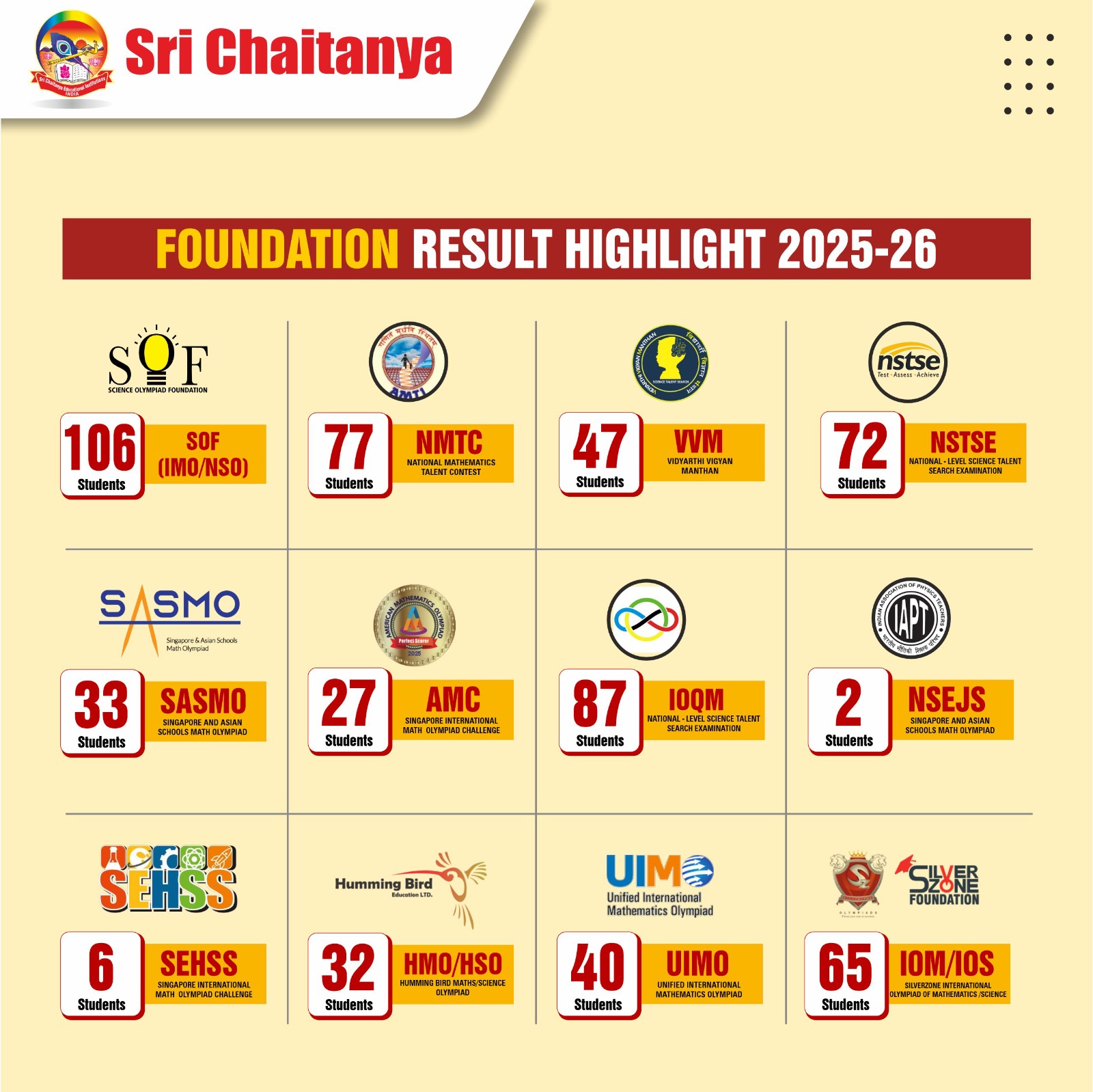
The Full Scoreboard: Sri Chaitanya Foundation Olympiad Results 2025-26
Here's every competition reflected in the results, with student counts:
| Competition | Full Name | Students | Category |
|---|---|---|---|
| SOF (IMO/NSO) | Science Olympiad Foundation — IMO & NSO | 106 | Math + Science |
| NMTC | National Mathematics Talent Contest (AMTI) | 77 | Mathematics |
| VVM | Vidyarthi Vigyan Manthan | 47 | Science |
| NSTSE | National Level Science Talent Search Examination | 72 | Science |
| SASMO | Singapore and Asian Schools Math Olympiad | 33 | Mathematics |
| AMC | American Mathematics Competition (MAA) | 27 | Mathematics |
| IOQM | Indian Olympiad Qualifier in Mathematics (HBCSE) | 87 | Mathematics |
| NSEJS | National Standard Exam in Junior Science (HBCSE) | 2 | Science |
| SEHSS | Singapore International Math Olympiad Challenge | 6 | Mathematics |
| HMO/HSO | Humming Bird Maths / Science Olympiad | 32 | Math + Science |
| UIMO | Unified International Mathematics Olympiad | 40 | Mathematics |
| IOM/IOS | Silverzone International Olympiad of Mathematics / Science | 65 | Math + Science |
Total student performances across all platforms: 596+ (note: individual students may have appeared in more than one competition).
Why the IOQM Number Stands Out
Among all the results listed, the 87 students in IOQM deserves the most attention — and ironically, it tends to get the least, because it doesn't come with a flashy logo or a familiar abbreviation.
The Indian Olympiad Qualifier in Mathematics, conducted by HBCSE (Homi Bhabha Centre for Science Education), is the entry gate to India's most selective math competition pipeline — the one that eventually leads to IMO representation for the country. Getting 87 foundation-level students to clear IOQM is a meaningful outcome, especially since this exam demands problem-solving that goes well beyond school curriculum.
This connects directly to something worth reading about: Sri Chaitanya North's INMO results — the next stage up from IOQM. Students who begin this journey at the Foundation level are the ones who eventually crack INMO. The pipeline starts here.
For parents evaluating coaching institutions for their Class 8–10 child, this number is worth noting more than almost anything else on that board.
From Foundation to INMO: The Larger Picture
It would be a mistake to read these Foundation results in isolation. The real value becomes clear when you trace what happens to students who start this Olympiad journey early.
One of the most striking recent examples is Kartik Garg's journey through INMO and IMOTC — a student whose path to national-level mathematics recognition began exactly the way these 596+ Foundation students are beginning theirs. Stories like his aren't accidents; they're the result of a pipeline that starts with Foundation Olympiad preparation and builds systematically over years.
Similarly, the INOI 2026 Gold Medal winner from Sri Chaitanya North demonstrated that when the conceptual foundation is strong and competitive problem-solving is introduced early, exceptional outcomes become possible — not just probable.
The SOF Results: Volume With Consistency
106 students performing in SOF's IMO and NSO is the largest single-competition count in this result sheet. SOF exams are widely taken across India — millions of students sit for these each year — which makes any distinction-level result genuinely competitive.
Getting 106 students to qualify for or perform at distinction level within that field isn't just a volume play. It indicates that the foundation batch is being prepared systematically — not just for JEE/NEET objectives, but for competitive math and science thinking from the ground up.
The SOF ecosystem (IMO for math, NSO for science) is also a strong early indicator of how students will handle aptitude-style reasoning in later competitive exams. Schools and parents who treat Olympiad performance as irrelevant to "real" board preparation are, in most cases, missing the point.
International Olympiads: SASMO, AMC, SEHSS — and What They Really Measure
Three competitions on this list are specifically international in character — SASMO (Singapore and Asian Schools Math Olympiad), AMC (American Mathematics Competition), and SEHSS.
These are taken by students across multiple countries and are not easy to qualify for. The fact that 33 students cleared SASMO and 27 performed well in AMC tells you something specific: the foundation batch isn't just being drilled on Indian exam formats. They're being exposed to problem structures that appear in Asian and global math competitions — a different kind of thinking, and arguably more transferable to higher-level competitive math.
For students who are aiming at ISI, CMI, or international math Olympiads in later years, this kind of early exposure matters considerably. It's also the kind of preparation that connects back to achievements like the INOI Gold Medal — where thinking laterally across problem types, rather than just pattern-matching to Indian formats, makes the critical difference.
NMTC: 77 Students in One of India's Oldest Math Talent Contests
The National Mathematics Talent Contest, run by the Association of Mathematics Teachers of India (AMTI), is one of the oldest and most respected math competitions in India. It's not flashy. There's no big prize. But it's taken seriously by mathematicians and educators because the problem quality is high and the selection is genuinely merit-based.
77 students from the Sri Chaitanya Foundation batch performing in NMTC is a number that speaks to the depth of the math curriculum. NMTC problems require actual mathematical reasoning — not formula substitution. This is the kind of preparation that pays dividends not just in board exams, but in JEE Advanced, where similar thinking is essential.
The NMTC-to-INMO pathway is also worth noting. Students who do well in NMTC at the Foundation level often go on to perform in INMO a few years later — the math reasoning muscles built in one translate directly to the other.
NSTSE and VVM: Science Talent Beyond the Classroom
72 students in NSTSE and 47 in VVM (Vidyarthi Vigyan Manthan) round out the science-side results.
VVM deserves a specific mention — it's a national-level program for science talent identification run under the Vijnana Bharati (VIBHA) initiative, supported by the Department of Science and Technology. It tests not just textbook knowledge, but scientific awareness and reasoning. Students who do well in VVM tend to have a genuine curiosity about science rather than just an ability to memorize formulas.
The 47-student VVM result suggests that the foundation curriculum at Sri Chaitanya North isn't completely exam-optimized at the cost of actual conceptual understanding — which is, frankly, a real concern with many coaching setups in India.
What Foundation Course Results Actually Predict
A common question from parents: does Olympiad performance in Class 8 or 9 actually predict JEE/NEET rank later?
The honest answer is: not directly — but it correlates strongly with the habits and thinking patterns that do. Students who learn to sit with difficult, unfamiliar problems at age 13 or 14 are far better equipped for the grind of JEE and NEET preparation than those who only ever practiced familiar question types.
Foundation courses serve a specific function: they build the conceptual layer underneath the formula layer. A student who understands why a mathematical result is true — not just that it is — handles JEE Advanced questions more flexibly.
The evidence is visible in the outcomes. Kartik Garg's INMO and IMOTC journey is one documented example of what happens when Olympiad preparation starts at the Foundation stage and is pursued seriously. These aren't outliers — they're the result of a system working as intended.
IOM/IOS: 65 Students in Silverzone's Math and Science Olympiad
The Silverzone Foundation runs one of the more widely-recognised private Olympiad platforms in India. 65 students in IOM/IOS (International Olympiad of Mathematics / Science) is a solid result, especially given that Silverzone competitions attract a very large national student base.
This brings the combined tally from broader Olympiad platforms (Silverzone, Humming Bird, UIMO) to 137 students — which shows that the batch is broad-based in its competitive participation, not just focused on a single high-visibility exam.
A Word on NSEJS: 2 Students, Maximum Difficulty
The 2 students in NSEJS might look like a footnote next to numbers like 106 or 87. But anyone familiar with the Indian science Olympiad structure knows that NSEJS is extremely difficult — it's the qualifying exam for the International Junior Science Olympiad (IJSO) pathway, conducted by HBCSE.
Getting even 2 foundation-level students to clear NSEJS is noteworthy. These students are typically in Class 9 and are competing against students with far more preparation in some cases. It's the kind of result that doesn't photograph well but means something real to those who understand the exam.
Final Thoughts: What to Look for When Evaluating a Foundation Program
If you're a parent or student trying to evaluate which foundation program is right for you, here's a practical lens for reading result infographics like this one:
- Breadth matters as much as depth. One top ranker is great for a banner. Consistent performance across 12 different competitions is harder to engineer and more meaningful.
- Look at the hard exams. IOQM and NSEJS are genuinely hard. Any institution showing real numbers there is doing something right in how they teach problem-solving.
- International exposure signals curriculum quality. SASMO, AMC — these test different thinking. Their presence in a result sheet tells you the teaching isn't purely India-exam-shaped.
- Foundation results don't guarantee JEE rank — but they're among the more honest early indicators available. The students behind the INMO results you read about today started exactly here.
Sri Chaitanya North's 2025-26 Foundation results, read carefully, make a reasonable case that the foundation batch is being prepared with both breadth and rigor. The numbers aren't inflated by a single easy exam — they're spread across platforms ranging from relatively accessible (SOF) to genuinely selective (IOQM, NSEJS, NMTC).
That's worth something, even if it doesn't fit neatly on a single slide.
Related Reading
- 📖 INOI 2026 Gold Medal Winner from Sri Chaitanya North
- 📖 INMO Results — Sri Chaitanya North Students
- 📖 Kartik Garg: From INMO to IMOTC — A Student's Journey
Have a question about Olympiad preparation or foundation courses? Drop it in the comments below — we read every one.